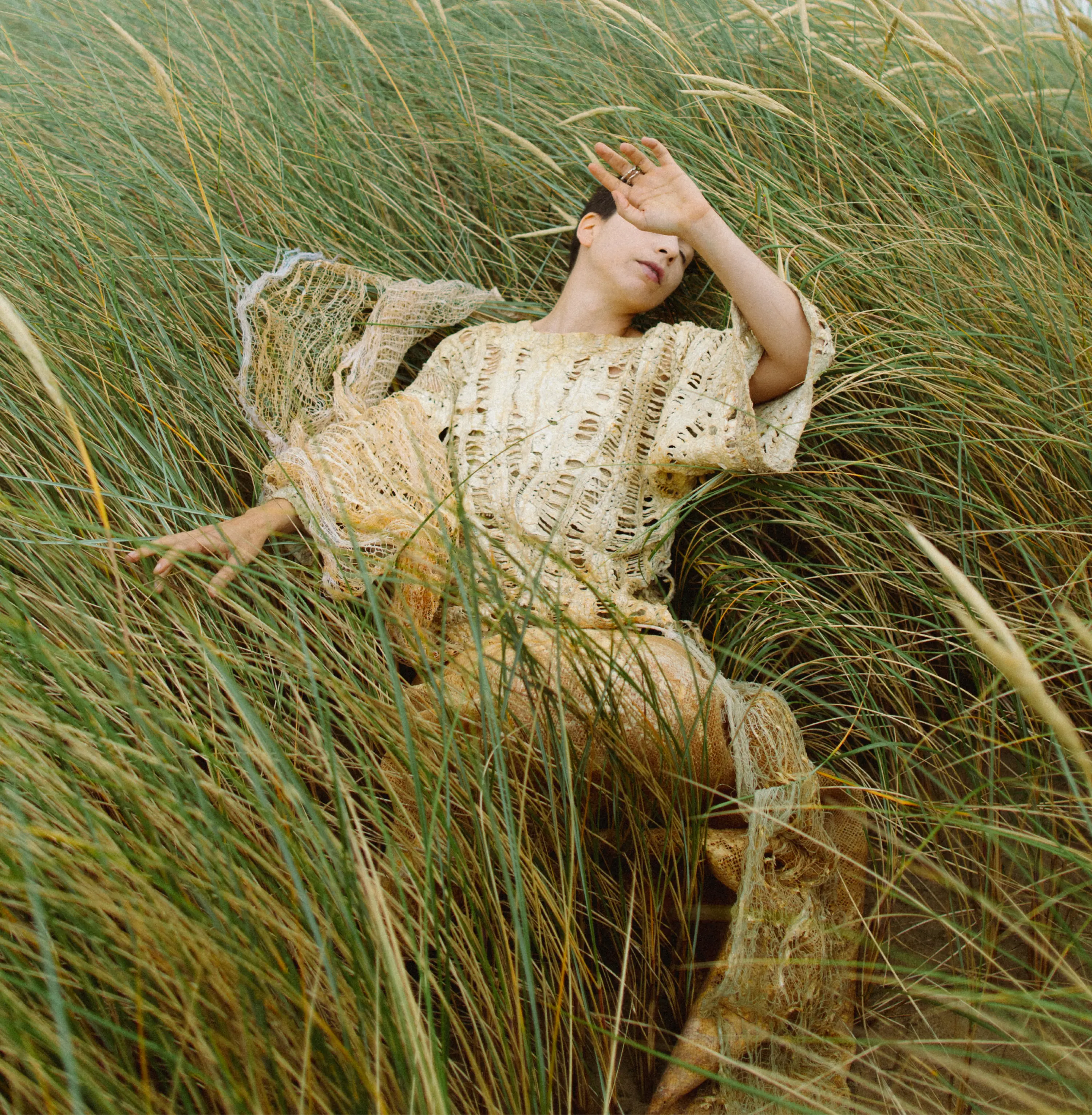
QOA is Nina Corti, a Buenos Aires sound and visual artist, as well as a fixture of Argentina’s experimental scene. Collaging field recordings, drones, live sampling and spoken word, they craft expanded listening experiences that attune you to the space around and within.
Emotional alchemy and intentional frequencies. Subtle harmonics and electronic textures blur in ‘Nagori’, an invitation to cross gently into the threshold states between dreams, waking and reverie.
Dreamstate Ambient
Calming Resonance
Altered States
- Sunyi 4:00
- Awan 2:58
- Nagi 4:08
- Komorebi 7:57
- Tsuyume 5:34
- Kosong 4:38
Saved
By The Drone
Sources artists
on influences, creative roots, inspirations, rituals and their releases on the
label.
Words by: Jamie Collins-Adams
Your Voice Is Really Here
We’re on a call thousands of miles apart from each other,
when Qoa notes how sound transforms any environment it enters; “Your voice
is really here in my space, and my voice is really there
in your space. We are moving the particles around us, even though
we are on different continents.” This approach to sound embodies
so much of the artist’s philosophy, one that feels as much about
observation and presence as it does production.
After a car crash at fifteen left them unable to play the piano
(which they had studied since the age of seven), the artist’s sonic
journey led to the discovery that virtuosity and beauty are not the same
errand. “What saved me was the drone and the looping.” The EP,
‘Nagori’ is full of melodic little flutters that feel
embellished with harmonic resonance, the simplicity Qoa alludes to, that stay
long after the note has faded. The name nagori (名残) is the Japanese word for
what lingers after something has gone, a trace or afterglow, the last
of a season. ⬤
“You don’t need to be a master at playing very
difficult stuff. I can still reach a sound I want through very
simple things. And there I went simple, simple, until the drone.”

“I had this feeling in mind of music that leaves space
for your own space of listening. One that leaves space for other sounds
to be part of the mix, the sounds of each person who
is listening.”
Call And Response
Headroom is a mixing term, the space you leave so that
sound has somewhere to move. Qoa uses it for everything.
“Even our life in cities, when people are stressed, it’s also
a matter of headroom. How much headroom do you have?”
According to the musician, what makes cities sound intolerable isn’t
so much volume, “it’s a floor of noise that we get
used to as normal. And it’s not normal.” A thriving
forest is also loud, but “all these sounds will be listening
to each other. They will be in conversation.” As opposed
to that, the smashing of construction sounds, traffic and noise
of urban environments has no call or response. “The
construction is not listening to you. That’s why it’s
invasive.”
The record is built to listen back. There are no vocals on it,
deliberately. “Instrumental music leaves space for people to add their
voice. Not music that occupies all the space, but that leaves space for other
sounds to be part of the mix, the sounds of each person who
is listening.” The sounds of your room are in the arrangement,
as part of the composer’s design. ⬤
Gradient States
The theme of ‘Nagori’ is the doorway most of us
cross twice a day without noticing: the stretch between being awake and
asleep. “This intermediate state before entering the oneiric
world,” Qoa calls it, “how this state could be a gradient
of states.” Not a specific threshold one steps over, rather
a longer slope with a great deal happening on it.
The drone is almost the perfect vehicle for this because of what
it does to time. Qoa has always been “obsessed with loops, and what
a loop can do”, a tone running long enough that you lose the thread,
a Balinese cycle in which “the end of the loop is the
beginning,” so that nothing announces itself as starting, you are
simply already inside it. ⬤
“When you open yourself to listen to what’s around you,
you give space to what is inside you to rise to the
surface.”
Magic And Science
Qoa travels everywhere with a recorder; this December they will
be recording whales off the coast of Chile. Having studied
electronic arts rather than music, they approach a place like
a researcher, taking material traces from rocks and rivers, wiring branches
with microphones until whatever was already there has become an instrument.
Nothing is settled in advance, “it’s slowly developing, but
I trust I have the image.”
Experiments are set running, then left to do what they will.
On a different song entirely, one they’re still mixing now,
a friend downstairs laughed loudly in the middle of a take.
“I tried to mix it out and couldn’t. It’s just
part of the mix now. At that moment they weren’t a close
friend, and now they are, so it makes sense that you’re
in my song with your laugh.” ⬤
“The more imperfect something is, the more valuable, because it says
it was made by a human. So: lucky me.”
Qoa is Nina Corti, a Buenos Aires sound and visual artist and a fixture of Argentina’s experimental scene. Qoa is Quechua for a mythological Andean wild cat, and for “that which transforms into something else”, which is what their work does, collaging field recordings, drones, live sampling and spoken word into extended states of listening.
With releases on Belgium’s Kraak Records, Sweden’s Fluere Tapes and LA’s Leaving Records, they craft expanded listening experiences that invite listeners to attune to both the surrounding environment and their own inner landscapes, entering a floating sense of space and time.
Back